Real-World Property-Based Tests as Lean Challenges
A benchmark for evaluating AI models and agents on real-world formal software verification.
About FVSpec
We scrape 11,039 property-based tests (PBTs) from real-world Python repositories, then automatically translate them into Lean 4 specifications with sorry placeholders. The result is a corpus of 9,415 Lean 4 verification challenges authored, in effect, by practicing engineers who had no formal verification goal in mind — putting our problems out of distribution relative to anything an AI is likely to have memorized.
Translating PBTs into Lean specifications is challenging: it requires modeling Python semantics in Lean, inferring the logical property encoded in an imperative PBT, and handling the inherent difficulties of dependently-typed programming in a seldom-used language. We describe a three-agent LLM pipeline for transpilation, evaluate coverage and quality metrics, and provide baselines for proof generation using several automated and model-based approaches.
Deduplicated Hypothesis PBTs scraped from public GitHub
Samples lifted from 2,772 PBTs (~8 theorems each, 75,005 total)
Permissively-licensed Python projects from 281 distinct GitHub owners
Classified as hard by a calibrated difficulty predictor — far from saturated
Baselines
We evaluate frontier models on 100 randomly sampled easy problems and 100 hard problems. Each model has access to the Lean LSP via MCP tools and is scored on a binary proved flag (zero sorry remaining and lake build succeeds) and partial credit (fraction of sorry placeholders removed).
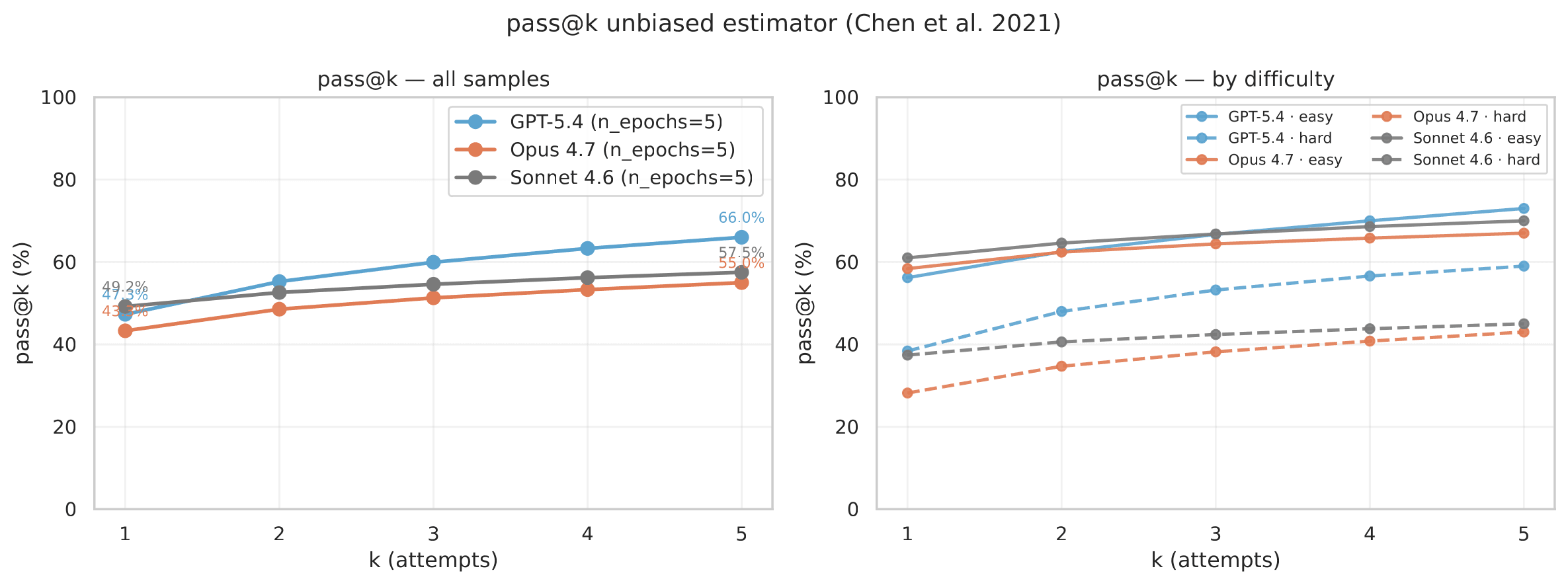
Across Claude Sonnet 4.6, Claude Opus 4.7, and GPT 5.4, models average 70% on easy problems and 49% on hard problems — the benchmark is far from saturated.